
Server-Side Platform Showdown: Stape vs TAGGRS vs Addingwell vs Tracklution

This is Part 2 of my server-side tracking series. If you missed Part 1 where I broke down the SST hype and introduced the hybrid approach, catch up here.
I know it’s been a couple weeks since my last post and while that might not seem long, it’s been enough time to dive deeper into these platforms, test more implementations, and watch how quickly things move in the tracking space. That’s how I’ve replaced Elevar with Addingwell going against my initial teaser, I decided because Elevar is only for Shopify advertisers, and I wanted to cover platforms that serve the broader market. Here’s what I found: these platforms are taking increasingly different approaches to solving the same problems, which makes choosing the right one more important than before.
Remember that 4+ week implementation timeline from my last article? The one where you have to research, configure, debug, and maintain server-side tracking while client-side solutions work with easy point-and-click tools?
Well, something has changed in the server-side tracking space.
Story time...
Back in 2022, my server-side implementations were basic. I’d hand clients a postback URL with instructions: “Trigger this when conversion events happen.” That was pretty much it until I discovered something during a client meeting that changed everything.
I found a seamless connection between server-side Google Tag Manager (sGTM) and Taboola, made possible by a template from a company called Stape.
That discovery opened up possibilities that never existed before and led me down a path of exploring SST solution providers like Stape, TAGGRS and recently Addingwell, Tracklution and others.
So let’s dive into what these solution providers actually are and what problems they solve.
What These Platforms Actually Are
Think of SST solution providers as making server-side tracking accessible. Just like Shopify made it possible to launch an online store without hiring developers, these platforms make it possible to implement server-side tracking without weeks of custom development.
But they’re not just hosting providers with fancy marketing. They’re solving each layer of complexity that makes SST hard to implement:
The Infrastructure Layer: Instead of dealing with Google Cloud Platform or any other server provider configurations and server scaling, you get managed infrastructure that handles traffic spikes automatically.
The Integration Layer: Instead of building custom connections to each advertising platform, you get pre-built templates and connectors for Meta, Google Ads, TikTok, and other platforms.
The Knowledge Layer: Instead of needing to build expertise across marketing attribution AND cloud infrastructure AND data engineering in-house, you get platforms designed for marketers but you still need someone who understands how to choose the right platform, configure it properly, and optimize your setup for your specific business needs.
The Core Problems They Solve
So how do these platforms actually solve those problems from my last article? Let me break it down.
From 4+ Weeks to 15 Minutes
Yes some platforms can bring the time to setup down to 15 minutes, AMAZING right!! This was impossible just a couple of months ago.
The traditional approach was lengthy and filled with challenges
It began from Researching the right technology required to setup SST → Configuring server on the chosen server platform → setup sGTM → Write custom tag code to fire postbacks → Debug → Test
The new platform approach asks you to connect your sGTM to the chosen platform → Configuring tags using platform templates → Debug → Test
So there are still some steps, but the platform handles the technical complexity and you get support if something goes wrong. This is what makes SST possible for marketing teams that don’t have deep technical resources.
Transparent Pricing
SST platforms solve this with pricing you can actually predict, simple per-request or per-event costs instead of GCP’s complex multi-component billing that can surprise you during traffic spikes.
The Marketer-Friendly Language
Platforms are increasingly moving away from technical language and making it marketing friendly. Some are even going an extra mile by making it intuitive and educational for marketers who are using SST for the first time.
Supporting The Hybrid Strategy
Quick recap on the hybrid strategy: keep behavioral tracking client-side using pixels (page views, time on site, scroll depth) and move conversions that matter for your marketing goals server-side (purchases, signups, lead forms).
These platforms make this practical. They give you the flexibility to track all events server-side but only send the ones that matter to your destination platforms. So you can capture everything in one place giving you a complete view of the user journey, while selectively pushing critical conversion events to ad networks.
This approach gives you three key benefits:
Better tracking management: All events captured server-side in one place makes debugging and maintenance simpler.
Complete visibility: You get a holistic view of the user journey and can compare server-side vs client-side data accuracy.
Best of both worlds: Ad platform algorithms continue to benefit from rich behavioral signals via client-side tracking, while your critical conversions get the accuracy boost from server-side implementation.
Platform Deep Dive: The Four Different Approaches
Each major platform has taken a distinct approach to solving SST complexity. Understanding these differences matters for making the right choice.
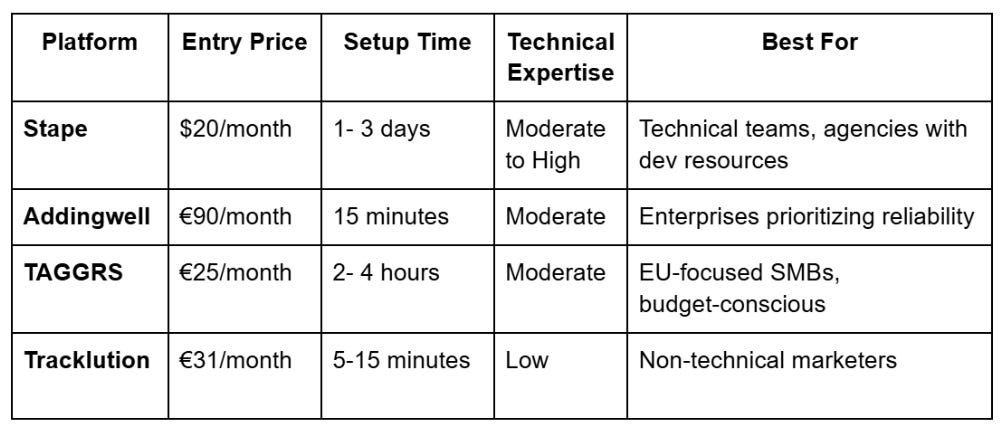
Quick Reference Overview
Stape: The Power User’s Platform
Stape is what I discovered back in 2022, and it remains the most technically sophisticated option. If SST platforms were cars, Stape would be a fully customizable race car incredibly powerful in the right hands.
What makes Stape different:
Extensive Template Library: Dozens of pre-built integrations covering major platforms (Meta, Google, TikTok, Outbrain) and niche affiliate networks (Awin, Rakuten, CJ, Webgains). This is what opened up that Taboola connection I mentioned earlier.
Active Template Development: Stape actively contributes to the GTM Template Gallery and continuously adds new templates based on customer requests.
Power-Up Ecosystem: Modular add-ons for specific functionality like GEO headers, user agents, cookie management.
Educational Resources: Stape Academy provides comprehensive training on server-side implementation and they regularly add new courses to up skill on.
When Stape makes sense:
Let’s say you’re an agency managing multiple clients with diverse tracking needs. You need sophisticated, customized tracking setups that would be impossible with simpler platforms. You have someone on the team who can navigate technical complexity.
The trade-off:
While more accessible than raw GCP, you still need technical understanding to maximize its potential. The learning curve is real.
Pricing reality:
Starting at $20/month sounds great, but costs can go up quickly with high traffic. The request-based pricing means a purchase event sent to 4 platforms (your site + GA4 + Meta + Google Ads) counts as 4 requests, not 1.
Addingwell: The Enterprise Reliability Option
Addingwell positions itself as the “set it and forget it” solution for companies wanting server-side tracking without the operational overhead.
What makes Addingwell different:
99.99% Uptime Guarantee: Enterprise-grade infrastructure with monitoring built in.
Proactive Support: Automated alert system if tag doesn’t reach 100% success.
Intuitive interface : making basic setup easy for non-tech marketers.
When Addingwell makes sense:
Let’s say you’re an established company running significant ad spend and you can’t afford tracking downtime. Think e-commerce brands doing 7+ figures who need reliability over customization.
The trade-off:
Premium pricing reflects the white-glove service. You get less flexibility for custom implementations compared to Stape.
Pricing reality:
€90/month entry puts it in enterprise territory, but it includes everything with no surprise costs for scaling or additional features.
TAGGRS: The Independent European Alternative
TAGGRS takes a different approach by building their own infrastructure independent of Google’s servers, which appeals to companies wanting to reduce Google dependency.
What makes TAGGRS different:
Own Server Infrastructure: Not dependent on Google Cloud Platform.
EU Data Residency: Servers located in EU for GDPR compliance.
Transparent Pricing: Simple, predictable cost structure.
When TAGGRS makes sense:
Let’s say you’re a European business prioritizing data sovereignty, or a company wanting to hedge against Google platform changes.
The trade-off:
Smaller ecosystem means fewer pre-built integrations. The interface can feel cluttered and slow to load compared to other platforms. Logs aren’t available..
Pricing reality:
Most cost-effective option for moderate traffic volumes. €25/month gets you serious capability.
Tracklution: The Plug-and-Play Solution
Tracklution approaches SST from a different angle: what if server-side tracking was as easy as installing a Facebook pixel?
What makes Tracklution different:
True Plug-and-Play: Install like any tracking pixel, works immediately.
Fully Managed Service: Zero server management or technical maintenance required.
Marketing-Focused Interface: Designed for marketers, not developers. But developer friendly features are available such as deep info on events and their data.
All-Inclusive Pricing: Single price covers hosting, maintenance, support, updates.
When Tracklution makes sense:
Let’s say you’re a marketing team without technical resources, or an agency wanting to offer server-side tracking without hiring developers.
The trade-off:
Least customizable option. You get what they provide which covers most use cases, but limits flexibility for unique requirements. Connections limited to only a few ad networks.
Pricing reality:
€31/month might seem higher than Stape’s entry price, but includes everything Stape charges extra for.
How These Platforms Solve The Core Problems
Here’s how these platforms address the specific problems I outlined in my last article:
Technical Complexity
Lowest Barrier: Tracklution (marketing-friendly interface)
Moderate: TAGGRS, Addingwell (guided setup)
Highest Capability: Stape (maximum customization)
Ongoing Maintenance
Zero Maintenance: Tracklution, Addingwell (fully managed)
Minimal Maintenance: TAGGRS (platform handles infrastructure)
Some Maintenance: Stape (you manage configurations)
Cost Predictability
Most Predictable: Tracklution, Addingwell (all-inclusive pricing)
Fairly Predictable: TAGGRS (simple request-based)
Variable: Stape (depends on traffic patterns and integrations)
Hybrid Strategy Support
All four platforms support the hybrid approach I recommended. Here’s how they compare:
Easiest for Hybrid: Tracklution makes this the simplest, it routes only your desired conversion events to ad networks while blocking the rest while giving you visibility into all events collected. The behavioral tracking stays client-side, critical conversions go server-side, and you get a complete view of everything.
Real Implementation Scenarios
Let me share some actual scenarios to make this concrete:
Scenario 1: The Growing D2C Brand
$25K monthly ad spend, small marketing team, no developers
The situation: Losing 30% of conversion data to iOS tracking restrictions, ad blockers or other tracking prevention systems but can’t afford weeks of implementation time.
Best fit: Tracklution or Addingwell
Tracklution for maximum simplicity
Addingwell if budget allows for premium support
Why not others: Stape requires too much technical investment, TAGGRS still needs moderate technical skills.
Scenario 2: The Performance Agency
Managing 50+ client accounts, technical team available or hired a tracking agency
The situation: Need flexible platform that can handle diverse client requirements and custom integrations.
Best fit: Stape
Massive template library covers edge cases
Community development adds new integrations
Technical team can maximize platform potential
Why not others: Other platforms limit the customization needed for diverse client base.
Scenario 3: The European Enterprise
€100K+ monthly ad spend, GDPR compliance critical
The situation: Need reliable SST with EU data residency and minimal operational overhead.
Best fit: Addingwell or TAGGRS
Addingwell for maximum reliability and support
TAGGRS for EU-independent infrastructure
Why not others: Tracklution lacks enterprise features, Stape requires ongoing technical management.
Platform Maturity
Most Mature: Stape (largest user base, most integrations, active community)
Rapidly Maturing: Addingwell (enterprise focus driving feature development)
Solid Foundation: TAGGRS (established but smaller ecosystem)
Newer Player: Tracklution (focused on simplicity over breadth)
After looking at all these differences, you might be wondering: which platform is actually right for me?”
So Which One Should You Choose?
The reality is that each platform succeeds because it optimizes for different priorities:
Stape maximizes capability and flexibility
Addingwell maximizes reliability and support
TAGGRS maximizes independence and cost-effectiveness
Tracklution maximizes simplicity and ease of use
There’s no universally “best” platform. The right choice depends on your current tracking setup, technical capacity, budget, specific integration needs, and traffic patterns. Getting this wrong means wasted time, money, and continued data loss.
Understanding which of these factors matters most for your specific situation is critical and often harder than it looks. What seems like a simple decision on the surface involves trade-offs between cost, complexity, customization, and long-term scalability.
Need help choosing and implementing the right platform for your business? I offer platform assessments that analyze your current tracking setup, recommend the right platform for your needs, and provide an implementation roadmap for the hybrid strategy. Email me at khushal.sr0605@gmail.com to discuss your situation or click below to send a message.
Ready to implement server-side tracking that actually works? Subscribe to Track with Khushal for practical insights that cut through the hype.